Why Finished Basements in Boulder Need ERV Ventilation
Finished basements in Boulder trap stale air, moisture, and radon because they sit below grade with little natural airflow. Here is why balanced ERV ventilation keeps every level fresh.

Walk downstairs in a lot of Boulder homes and the air changes. It feels heavier, a little stale, maybe faintly musty. The finished basement looks great. New carpet, a sectional, the kids' play area, maybe a guest bedroom. But the air down there tells a different story, and it is not just your imagination.
Below-grade rooms trap everything. Moisture seeps through foundation walls. Radon rises from the soil. Cooking smells, cleaning products, and plain old exhaled air have nowhere to go because basement windows are small, few, or painted shut. An ERV installed for the whole house changes that equation by giving the lowest level what it cannot get on its own: steady, balanced fresh air.
Why Below-Grade Rooms Trap Bad Air
Physics works against basements. Warm air rises, so the stack effect pulls air upward through the house all winter. That leaves the basement slightly depressurized, which tugs soil gases and moisture inward through every crack and joint. Meanwhile the air that does reach the basement tends to sit there. There is no cross breeze. The windows, if they open at all, are tiny hopper windows near the ceiling.
Boulder County makes it worse in a specific way. Many homes here have finished basements that serve as real living space. Bedrooms, home offices, playrooms, home gyms. Families spend hours a day breathing basement air. In Louisville and Lafayette, newer tight construction keeps conditioned air from leaking out, which also keeps pollutants from diluting. The basement becomes a bowl that collects whatever the house produces.
You can feel it. Guests notice it before you do because you have gone nose-blind. That heavy, flat feeling when you come down the stairs is stale air, and no amount of air freshener fixes the cause.
The Moisture Problem Nobody Warns You About
Concrete is porous. It wicks moisture from the surrounding soil constantly, even when there is no visible leak. In summer, warm humid outdoor air hits cool basement walls and condenses. That is why the corners feel damp in August and why the cardboard boxes down there get soft.
Persistent dampness feeds mold and dust mites, and it ruins finishes. Paint bubbles. Baseboards warp. Carpet padding turns into a science experiment. A dehumidifier helps with the symptom, but it just wrings water out of air that never actually leaves. The stale air stays stale, only drier.
Ventilation attacks the root. By continuously replacing humid basement air with drier outdoor air, an ERV keeps relative humidity in the range where mold struggles and finishes survive. It does the job quietly in the background instead of asking you to empty a bucket every other day.
Radon Collects Where Your Family Hangs Out
Boulder County sits in EPA Radon Zone 1, the highest potential category. Radon is heaviest at the lowest level of the home, which means the finished basement, the exact place where the kids play and guests sleep, typically has the highest concentrations in the house.
An ERV dilutes radon the same way it dilutes everything else: steady air exchange. It cannot replace dedicated mitigation if your test reads at or above 4 pCi/L, but it keeps residual levels down and protects the gains after mitigation goes in. Our guide on how ERVs help with radon in Boulder County homes walks through the limits and the right order of operations. If you have never tested, an indoor air quality assessment is the sensible starting point.
How an ERV Fixes Basement Air Without Wasting Heat
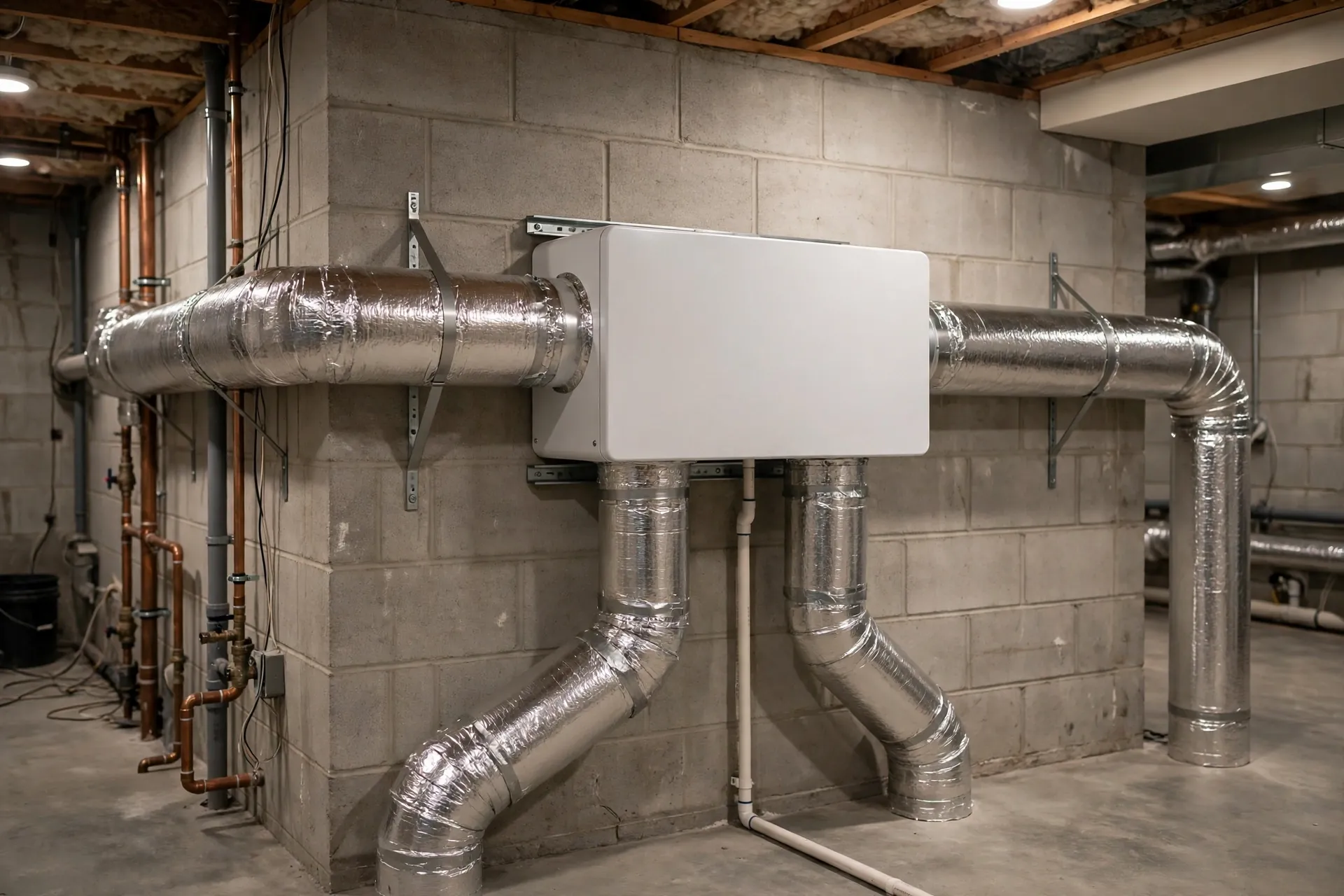
The obvious objection is energy. If you ventilate the basement in January, are you not just dumping heated air outside? That is exactly the problem ERVs were designed to solve. The core transfers heat from the outgoing stale air into the incoming fresh air, so you get the air exchange without the energy penalty of an open window or a bath fan running all day.
Balance matters as much as heat recovery. A bath fan only exhausts, which deepens the basement's negative pressure and can pull in more radon and soil gas while it runs. An ERV supplies as much air as it removes. No added suction, no backdrafting risk on the water heater or furnace, just a calm, continuous swap. That balanced flow is also why proper airflow balancing and commissioning matters so much on every install.
The result is air that feels like the upstairs: neutral, fresh, unremarkable. Which is exactly what you want. Nobody ever compliments good basement air. They only notice when it is bad.
Getting the Layout Right in a Finished Basement
Placement decides how well the system works. Exhaust pickups belong low, near the floor where radon, moisture, and heavy stale air collect. Supply air goes to the rooms where people actually spend time: the bedroom, the office, the play area. Done right, fresh air sweeps across the living space before the exhaust pulls the old air out.
Sizing follows the same logic as the rest of the house. Our ERV sizing guide explains how capacity gets matched to square footage and layout, and basements count fully toward that math. A finished basement is not bonus space. It is living space, and the ventilation design should treat it that way. Skimp on the basement and the whole system's balance suffers.
What Changes After the ERV Goes In
The first thing most homeowners notice is the smell, or rather the absence of it. That musty basement signature fades within days. Then the subtler stuff: less condensation on the basement windows in winter, fewer headaches during long work-from-home days downstairs, guests who stop commenting on the air.
Over the longer term, finishes last longer and the HVAC system stops fighting humidity it was never designed to handle. Keep the filters changed and the core cleaned, and the system hums along for years. Our ERV maintenance and tune-up visits cover exactly that, so the basement keeps breathing right without you thinking about it.
A finished basement should feel like part of the house, not a bunker underneath it. Balanced ventilation is what makes that true. Test your air, size the system to the real living space, and let the ERV do the quiet work of keeping every level fresh.
Related guide: Can an ERV Help Reduce Radon in Boulder County Homes?